
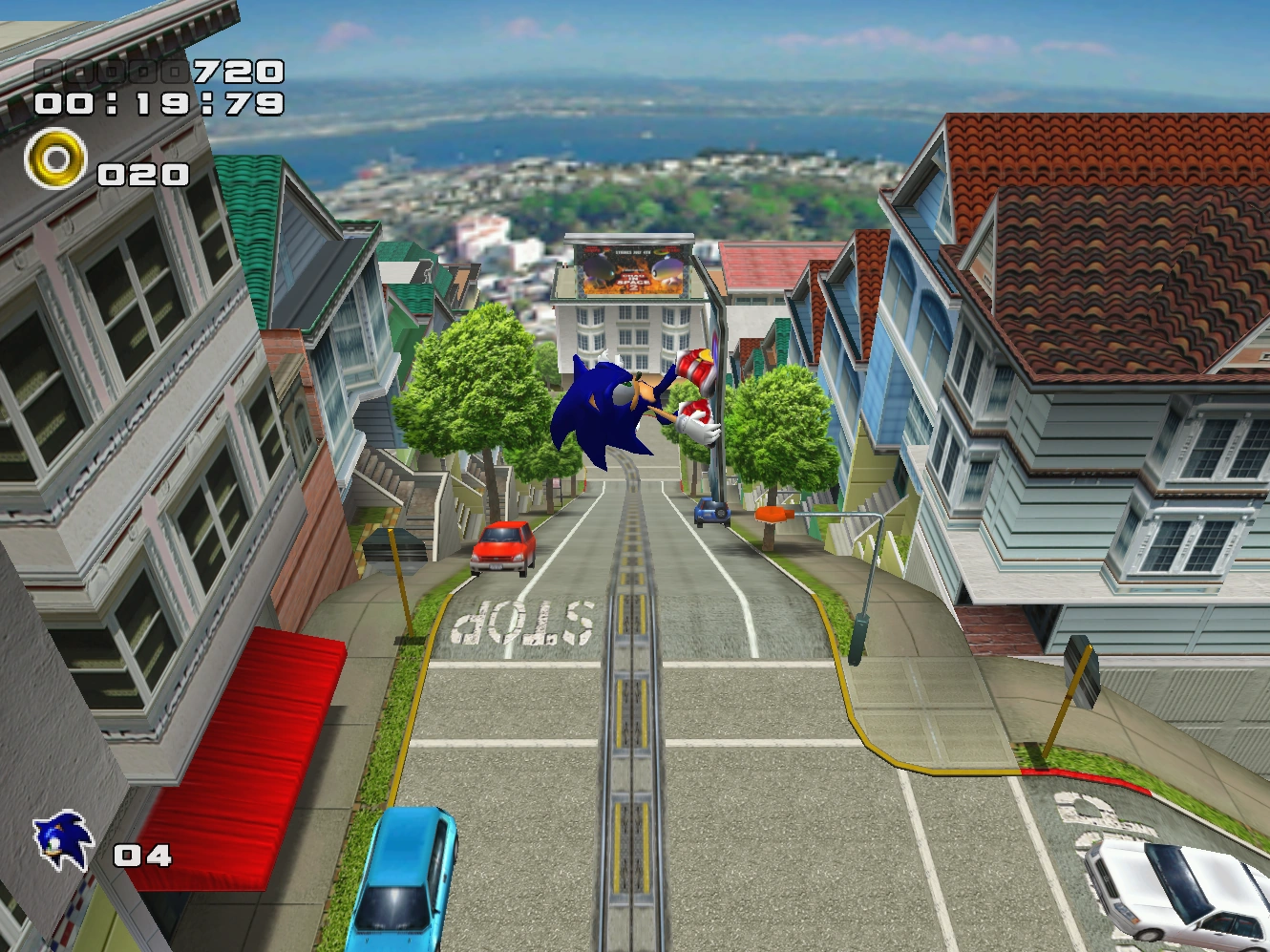
You’re snowboarding down a San Francisco hill, a massive truck chasing you from behind. The speakers explode with “Rolling around at the speed of sound—”. In that instant, you know this game is something different.
Sonic Adventure 2. Released in the summer of 2001 on the Sega Dreamcast, this wasn’t just “a good Sonic game.” It was the moment when Sonic as a character and as a franchise shone the brightest. And simultaneously — it was the final breath of Sega’s hardware empire. A game born under impossible circumstances, finished under impossible pressure, and still played 25 years later. This is the story of why SA2 matters.
The Ground Collapsed While They Were Still Building
In September 1999, eleven core members of Sonic Team relocated from Japan to San Francisco. Led by director Takashi Iizuka, this crew — Sonic Team USA — had one clear mission: create a sequel that surpasses the original Sonic Adventure in every way. They set up shop in the Bay Area, drawing inspiration from the city’s steep hills, urban sprawl, and freeway culture — all of which would directly shape the game’s most iconic stages.
The original Sonic Adventure had been a launch title success for the Dreamcast. It proved that Sonic could work in 3D, but it was rough around the edges. Iizuka’s team knew SA2 had to be tighter, faster, and more cinematic. They spent over a year refining the engine, designing levels, and building a narrative that split between hero and villain perspectives — something no Sonic game had attempted before.
Then on January 31, 2001, a bombshell dropped from Sega headquarters in Tokyo. “We are immediately ceasing Dreamcast production.” An 18-year hardware legacy — from the SG-1000 to the Master System, Genesis, Saturn, and Dreamcast — was done. The PlayStation 2 had steamrolled the market, and Sega was hemorrhaging money. From that day forward, Sonic Team USA knew — the game they were building would be the last Sonic title to ever appear on a Sega console.
But they didn’t stop. If anything, they ran harder. They hit the June 2001 release date, deliberately aligning it with Sonic’s 10th anniversary (the original Sonic the Hedgehog debuted on June 23, 1991). Iizuka later reflected: “If only SA2 had been better, maybe the Dreamcast could have kept going.” — That regret, that weight of knowing you’re building the last chapter, seeps through every corner of this game. It’s why SA2 feels different from other Sonic titles. There’s an urgency to it, a sense of “we’re going to make this count.”
Three Flavors on One Plate
SA2’s gameplay splits into three distinct styles, each assigned to a pair of characters — one hero, one villain.
Speed Action — Sonic and Shadow stages. This is the game’s beating heart, the reason people still talk about SA2 a quarter-century later. City Escape, Final Rush, Radical Highway, Metal Harbor… Running at a locked 60fps on the Dreamcast — a technical achievement for 2001 — with a development team that deliberately designed levels to “make Sonic feel faster than he actually is.” Camera angles that pull back at just the right moment to reveal a massive descent. Terrain placement that guides your eye before your hands even react. Music tempo synchronized to the action so seamlessly that the whole experience feels like a choreographed music video. There’s a reason Polygon called City Escape “the epitome of Sonic the Hedgehog.” It’s not just a level — it’s a statement of what Sonic is supposed to feel like.
Shadow’s stages mirror Sonic’s speed but with darker aesthetics and heavier atmosphere. Radical Highway, set on a suspension bridge at night with helicopters and searchlights, remains one of the most visually striking stages in any Sonic game.
Shooting — Tails and Eggman pilot bipedal mechs and blast through waves of enemies. These stages play like on-rails shooters with free movement — lock on to multiple targets, release, and watch the chain explosions. The impact is surprisingly satisfying. Tails’ stages on Prison Island and Eggman’s assault on the space colony ARK provide some of the game’s most explosive set pieces. It’s a completely different tempo from the speed stages, and that contrast keeps the game from feeling one-note.
Treasure Hunting — Knuckles and Rouge search for hidden Emerald shards across sprawling maps. This is where opinions divide, and honestly? I get it. The radar flickers faintly — it’s close. You climb up a wall, nothing. Drop back down, the radar lights up again. You spin the camera around, still nothing. In Meteor Herd, you find yourself floating through a massive space station for 20 minutes straight, muttering “where IS this thing?” to nobody. The hint system is cryptic at best. You start questioning your spatial awareness, your life choices, everything.
But here’s what’s strange — in Pumpkin Hill, with Knuckles’ rap pouring through the speakers as you dig through a Halloween graveyard, the Emerald is nowhere in sight, and yet somehow you don’t want to put the controller down. There’s something hypnotic about the search. The maps are so atmospheric, the music so perfectly matched, that wandering becomes its own reward. Aquatic Mine’s eerie underwater tunnels. Death Chamber’s ancient Egyptian ruins. Rouge’s stages in Security Hall with its jazz soundtrack turning a timed Emerald hunt into something almost relaxing. That peculiar pull, that love-hate relationship with the radar — that’s treasure hunting.
Clear both the Hero Story (Sonic/Tails/Knuckles) and the Dark Story (Shadow/Eggman/Rouge), and the Last Story unlocks — both sides unite against a common threat, the Biolizard and its final form, the FinalHazard. This dual-narrative structure, where you play the same events from opposing perspectives before they converge, was genuinely refreshing for 2001. It gave every character motivation and screentime. Shadow’s backstory with Maria on the Space Colony ARK is still one of the most emotionally resonant moments in Sonic history.
The Chao Garden: A Black Hole for Your Time
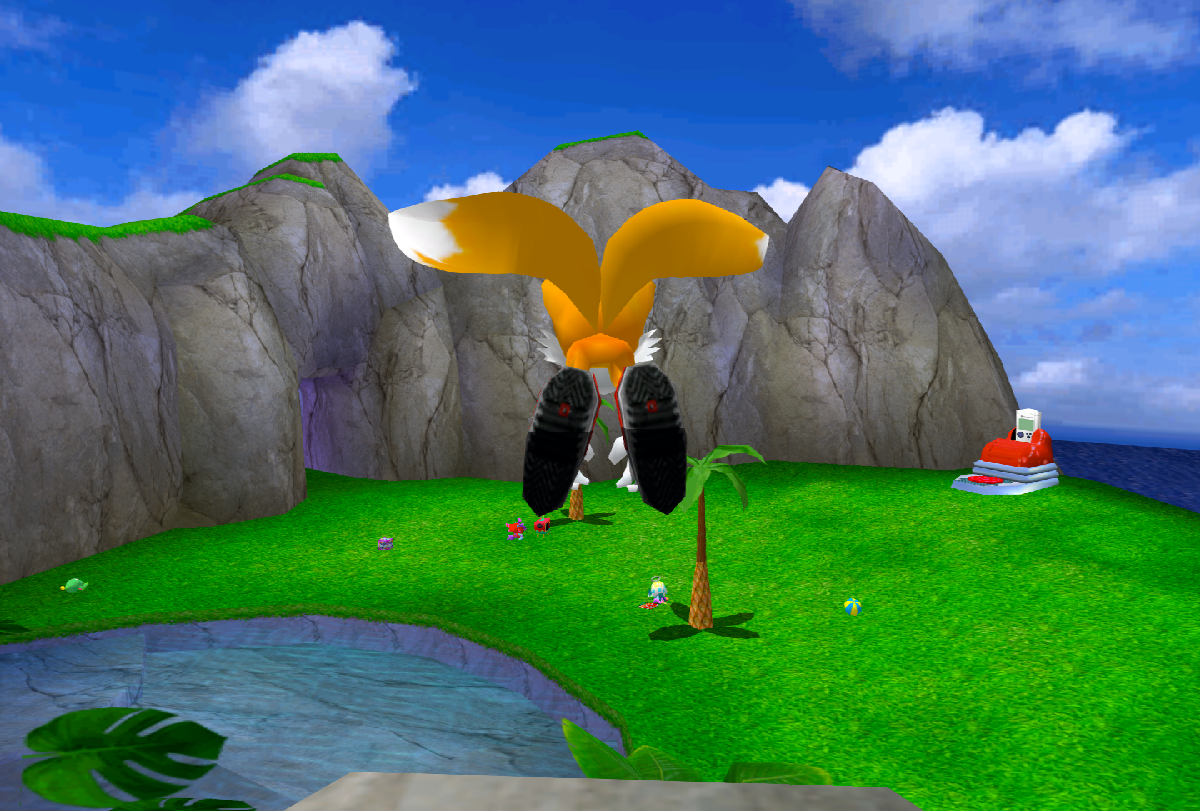
You bought an action game. You ended up playing a pet simulator. That’s exactly what happened to thousands of players, and most of them wouldn’t have it any other way.
The Chao Garden is a mini life-simulation buried inside SA2. Three gardens — Neutral, Hero, and Dark — each with their own atmosphere and music. Feed your Chao the small animals and Chaos Drives collected from action stages, and watch their stats grow in swimming, flying, running, power, and stamina. Their appearance changes based on what you feed them. Give a Chao enough Dark-aligned animals and it evolves into a sinister-looking Dark Chao. Raise it with Hero characters and it sprouts a halo. There are dozens of evolution paths, rare color variations, and hidden combinations that players are still documenting on fan wikis in 2026.
Enter your Chao in races — swimming through underwater tunnels, running obstacle courses, flying through rings. The Chao Karate lets them fight. The Kindergarten teaches them instruments and lessons. It’s absurdly deep for what’s essentially a side feature in a platformer.
“Let me just feed the Chao real quick before the next stage” — that “real quick” is a minimum of 30 minutes. I guarantee it. When you see your Chao falling asleep, curled up on the grass, you simply can’t bring yourself to turn off the console. You sit there, watching it sleep, thinking “maybe I’ll just do one more stage to get some better animals.” And the cycle begins again.
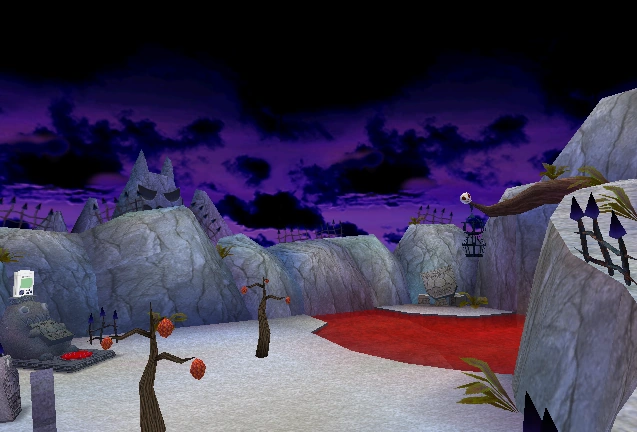
The Chao Garden is often cited as the single feature fans most want to see return. Sonic Team knows this — they’ve acknowledged the demand repeatedly — and yet no Sonic game since has replicated it at the same depth. Some things, it seems, were lightning in a bottle.
A Soundtrack Where Every Character Gets Their Own Genre — And It’s Genius
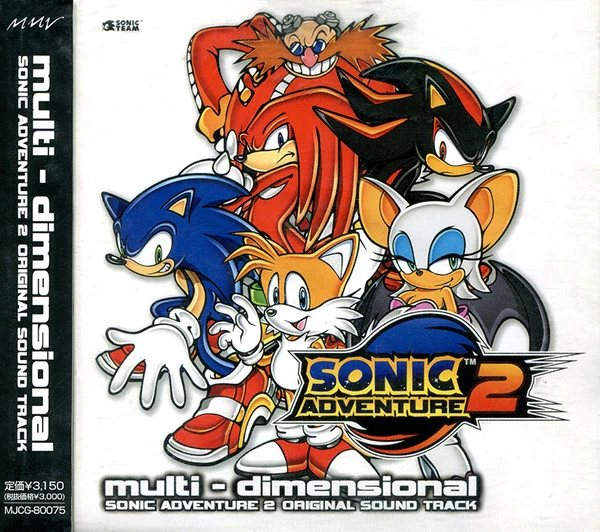
Most game soundtracks maintain a consistent tone throughout — orchestral, electronic, ambient, whatever the chosen palette. SA2 throws that convention out the window. It assigns a completely different music genre to each character. The result is an album called “Multi-Dimensional” that literally lives up to its name. This was an audacious experiment in 2001, and it still feels bold in 2026.
- Sonic — Pop rock. “It Doesn’t Matter” is his character theme, a declaration of carefree confidence. And City Escape’s “Escape from the City” is… just an all-time favorite. It’s the song that defines Sonic for an entire generation. Composed by Jun Senoue, vocals by Ted Poley and Tony Harnell (NOT a Crush 40 song — a common misconception that even some official materials have repeated). The moment that opening riff kicks in as you’re bombing down the hill, you understand why this franchise endured.
- Knuckles — Hip-hop/rap. “Pumpkin Hill,” rapped by Hunnid-P, gets stuck in your head for days. “Here I come, rougher than the rest of them—” It shouldn’t work. A rap track in a Sonic game? In 2001? But it does. It works brilliantly. Every Knuckles stage has its own rap track, each one more absurdly catchy than the last. “Aquatic Mine” is smooth underground hip-hop. “Meteor Herd” goes hard with industrial beats. It’s a mini rap album hidden inside a platformer.
- Rouge — Jazz/lounge. You have no idea where the Emerald is, but the jazz flowing through your ears is so smooth that you just keep wandering the map anyway. Rouge’s stages feel like infiltrating a casino at midnight. The saxophone and piano create an atmosphere so disconnected from the rest of the game that it’s almost surreal — and that’s exactly why it works.
- Shadow — Hard rock. Dark, heavy guitar riffs matching his brooding, tortured character. “Throw It All Away” captures his existential crisis in a way that no dialogue could.
- Eggman — Dark techno/electronic. Pulsing synths and driving beats. The perfect soundtrack for piloting a walking death machine and demolishing everything in your path.
And tying it all together: the main theme, “Live and Learn” (Crush 40, vocals by Johnny Gioeli). An instrumental version plays on the title screen — you hear it every time you boot up the game, and it sets the tone before you even press start. Then, when you’ve fought through every story, cleared every stage, and reach the Last Story’s final boss, FinalHazard — the moment Super Sonic and Super Shadow transform in the vacuum of space, the full vocal version explodes. It plays again during the ending credits as the story resolves. A single song that bookends the entire game, from your first moment on the title screen to the final frame of the credits. Vice described this soundtrack as “era-defining.” They weren’t exaggerating.
Birthday Pack — A Legend That Existed for Only Two Days
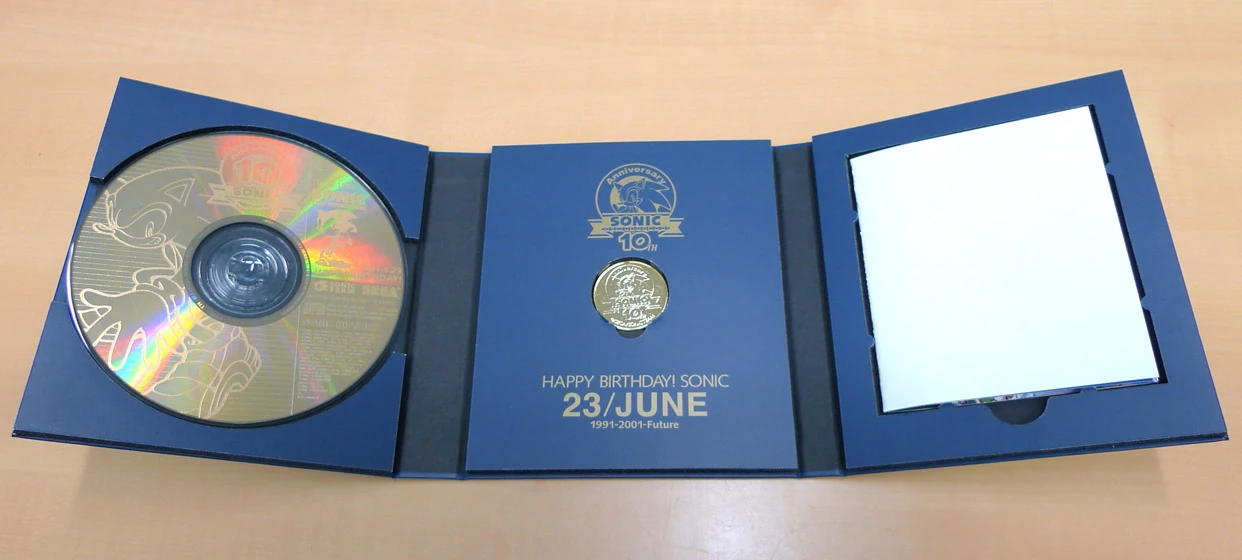
June 23 to 25, 2001. Just two days. Japan only. The Sonic 10th Anniversary Birthday Pack.
Open the blue trifold display box and inside you’ll find three items alongside the game disc:
- Gold Sonic Coin — Engraved with “10th Anniversary” on one side and Sonic’s classic pose on the other. Weighty, with a clean gold finish that still looks stunning decades later.
- Gold Music CD — A greatest hits collection spanning 10 years of Sonic music, from the Genesis era chiptunes to the Dreamcast-era rock tracks.
- 17-page History Booklet — A booklet chronicling the series’ decade-long journey with rare concept art and developer commentary.
Plus the SA2 game disc itself, of course. After just two days, it was pulled from store shelves and replaced by the standard edition. Today, a complete Birthday Pack in good condition on eBay or Yahoo Auctions Japan commands serious collector premiums — often several hundred dollars. It’s become one of the most sought-after pieces of Sonic memorabilia, a physical artifact from the exact moment Sonic turned ten and the Dreamcast said goodbye.
Reaching More Players — From Battle to Steam
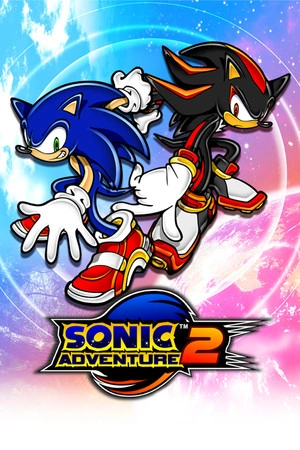
If SA2 had stayed Dreamcast-exclusive, it would have quietly faded at around 500,000 copies — a game released just as its host console was being discontinued. But Sega’s transition to third-party development gave this game a second life that no one could have predicted.
Sonic Adventure 2: Battle (GameCube, December 2001) — This wasn’t just a port; it was a genuine expanded edition. The multiplayer battle mode gained 21 new stages, new playable characters in VS mode, and the Chao system got substantial additions: Black Market for buying rare items, Fortune Teller for naming your Chao, and Chao Karate for combat tournaments. Connect a Game Boy Advance via link cable for the Tiny Chao Garden — a portable version that let you raise Chao on the go, feeding them fruits and playing minigames during your commute.
For everyone who never owned a Dreamcast — and by 2001, that was the vast majority of gamers — this was their first chance to experience SA2. And it showed, selling 1.7 million copies to become the best-selling third-party title on the GameCube. For many players, SA2 Battle IS the definitive version. It’s the one they grew up with, the one that introduced them to Shadow, to the Chao Garden, to “Live and Learn.”
(Though the Chao Garden was slightly scaled down from the Dreamcast original, and the DC version’s VMU minigame — where you could raise a Chao on the memory card’s tiny screen — and online leaderboard features didn’t make the cut. That’s one of the reasons the Dreamcast original still holds a special place for those who experienced it first.)
HD Remaster (2012) — Released digitally on PS3 (PSN), Xbox 360 (XBLA), and PC (Steam). 720p widescreen support was added, though it was built on GameCube-era assets rather than receiving a full visual overhaul. Battle content was available as separate DLC for a few extra dollars. While the HD version doesn’t dramatically improve the visuals, it made SA2 accessible to an entirely new generation of players who had never touched a Dreamcast or GameCube.
The Steam version deserves special mention because it’s still available and actively played today in 2026. The PC modding community has embraced SA2 with open arms — texture replacements, model swaps, custom stages, widescreen fixes for modern monitors, and even a mod that restores the Dreamcast’s original lighting. Fourteen years after the HD port launched, players are still finding new ways to experience this game.
Dreamcast (2001) → GameCube (2001) → PS3/Xbox 360/Steam (2012). A game that’s spanned four generations of gaming platforms over 25 years. That’s not nostalgia talking — it’s proof that the demand for this game never really went away.
Sonic’s Peak Was Right Here
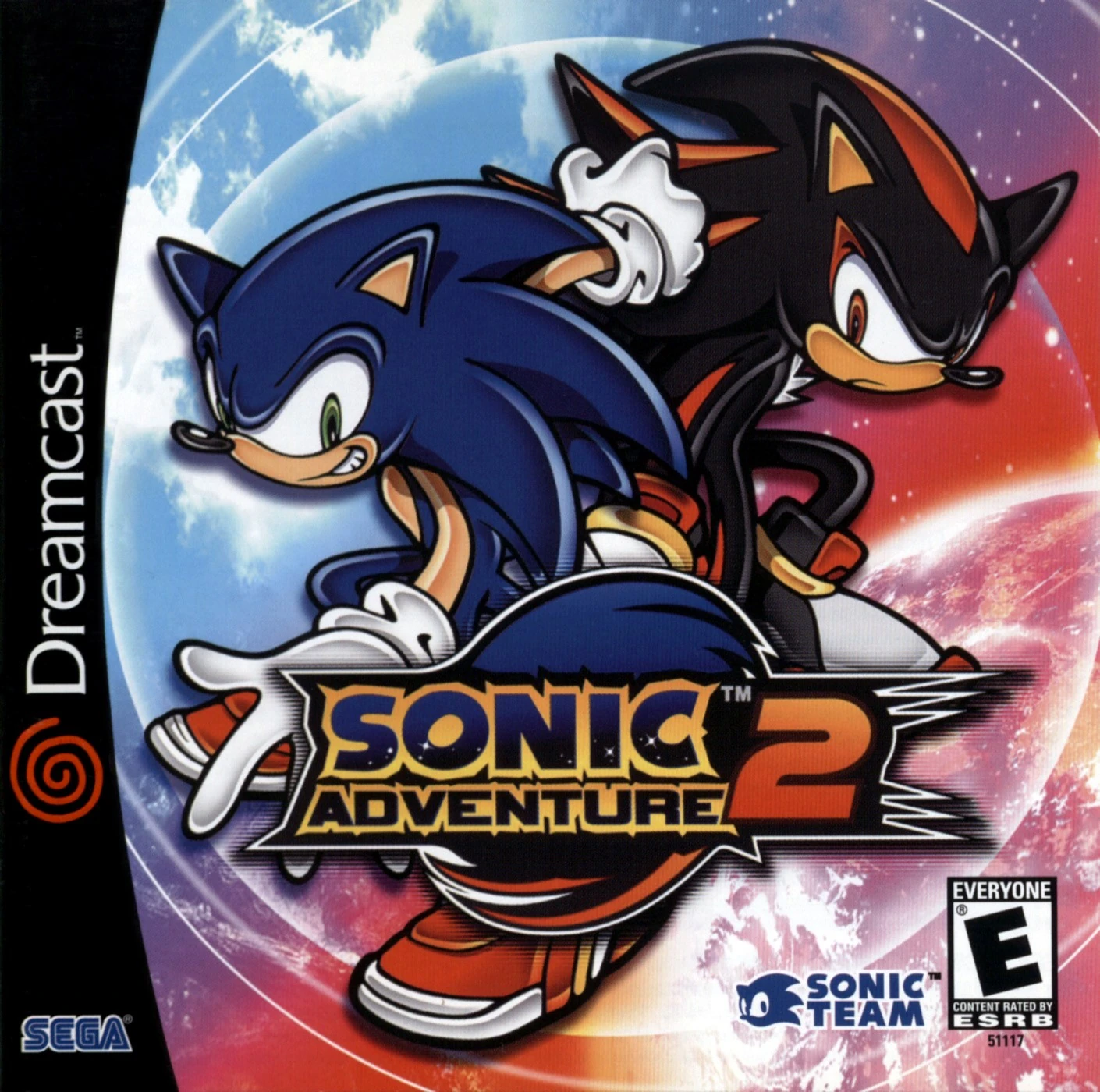
Metacritic 89. IGN gave it 94 and wrote: “It’s satisfying to know that the DC didn’t go out with a bang, but with a sonic boom.” GameSpot praised the variety and ambition. Even critics who found the treasure hunting stages frustrating acknowledged that SA2 was something special — a game that swung for the fences on every front.
And after SA2? Sonic Heroes (2003) was decent enough, if a bit formulaic. Then Shadow the Hedgehog (2005) inexplicably put guns in his hands and added branching morality paths that nobody asked for. And Sonic the Hedgehog (2006) — colloquially known as “Sonic ’06” — was a full-on nosedive that nearly killed the franchise. Loading screens that lasted longer than some stages. A story involving a human princess kissing a dead hedgehog. The energy SA2 had, the experimental boldness of its soundtrack, the tension of its narrative, the care in its level design — none of it ever came back in quite the same way.
Recent titles like Sonic Frontiers (2022) have shown flashes of ambition, and the Sonic movies have revitalized public interest in the character. But ask any long-time Sonic fan when the series peaked, and you’ll hear the same answer over and over: SA2.
SA2 isn’t just “the best Sonic game.” It’s “the moment when Sonic was most Sonic.” The platform was collapsing beneath their feet — literally, the hardware manufacturer was going bankrupt — but Sonic Team USA kept running until the very end. They poured everything into this game because they knew it might be their last chance. And 25 years later, the result is still available on Steam for a few dollars, Escape from the City still makes your heart race, and somewhere, someone is still feeding their Chao at 2 AM.
If you haven’t played it, you can pick it up on Steam right now. If you have — you know. That first City Escape. That feeling. Some games you play. Some games become part of you.
Curious about the Dreamcast console itself? Check out our deep dive: Sega’s Last Spark, Dreamcast: From Development Secrets to Masterpiece Games.
Game screenshots and official artwork used in this article are property of Sega/Sonic Team and are used under Fair Use for review and commentary purposes. All trademarks belong to their respective owners.